

The Port Hope fish migrations are among Mother Nature's most impressive wonders. Thousands of salmon and trout swim upstream and jump the fish ladder to migrate to their spawning grounds.
Fishing in the Ganaraska River
New Seasonal Sanctuary: A new seasonal sanctuary (area B) for all fish species has been established by the Province of Ontario in the Ganaraska River from September 1 to October 14. Visit Ontario Fishing Regulations for Zone 17 for more details. Enforcement in Effect! If you witness inappropriate behaviour, please report it.
| Zone | Regulations | Fishing Map |
|---|---|---|
| Area A | No Fishing Allowed Area: From highway 401 downstream to the south side of Jocelyn Street Bridge NO FISHING - CLOSED ALL YEAR | Image 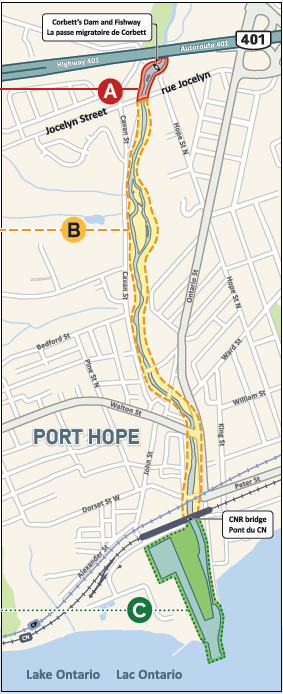 |
| Area B | Fishing Season Area: From the south side of the Jocelyn Street bridge to the south side of the CNR right-of-way. OPEN Fishing Seasons - from the fourth Saturday in April to August 31 and from October 15 to December 31 | |
| Area C | Fishing Permitted Area: From the south side of the CNR right-of-way to Lake Ontario. OPEN for fishing all year round. Applies to species of Atlantic Salmon, Brown Trout, Pacific Salmon and Rainbow Trout |
The Ganaraska River in the Municipality of Port Hope is one of the healthiest rivers in Ontario and is populated almost entirely with wild, naturally reproducing fish. The River offers some of the most diverse fishing experiences in the Province, drawing people from far and wide to fish and watch the fish migrations each year. Additionally, our Boat Launch, Marina, and Fish Cleaning Station on our waterfront ensures that the fishing experience in Port Hope exceeds your expectations. Note: Fishing the River is not accessible by private property. Land owners have rights that are supported by Police and By-law enforcement teams.
Thousands of fish swim against the current to head home
People come every weekend from mid-August to early October to watch the 5,000 to 19,000 Chinook and silvery Coho Salmon swim from Lake Ontario up the Ganaraska River that runs through Port Hope on their way to their home spawning grounds. And as many as 9,000 trout a year make the same journey from late March until early May, or through October until mid-December. Fish fact: The Ganaraska River is one of the healthiest small rivers into Lake Ontario, populated almost entirely with wild naturally-reproducing fish.

The Fish Ladder at Corbett's Dam
The Ganaraska Fishway has the best vantage point for seeing these fish in action. *No fishing allowed in this area. The fishway is more commonly known as the Fish Ladder, which is managed by the Ministry of Natural Resources and Forestry (MNRF) including an underwater monitoring system that lets you watch the fish! It records the number of fish that pass through to travel to their spawning grounds, as well as the species, size, and health. The Fish Ladder is located on the west side of Corbett's Dam (the dam is managed by the Ganaraska Region Conservation Authority) at 4 McKibbon St, Port Hope. Latitude: 43.95117 Longitude: -78.29299.
Pooling Locations in Downtown Port Hope
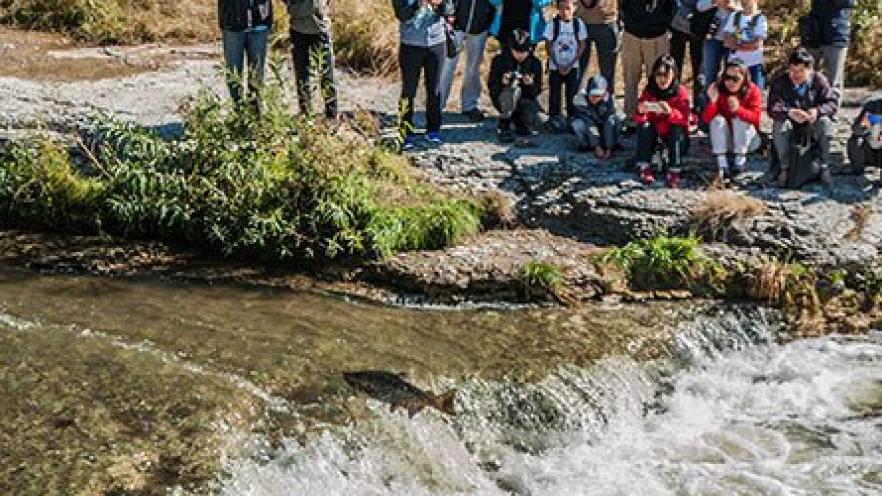
You can see the pooling stations for fish in the shallow water at various points along the river in town. Riverside trails provide some of the best viewing spots and will take you up the river upstream to the Fish ladder.
Respect our natural resources
Planning to visit Port Hope to fish or watch the salmon migration this year? Take only what you need and follow protocols and fish limits, per Ontario Fishing Regulations. Our river and waterfront are some of our most cherished natural resources. We want you to experience and enjoy our waterways, and we ask that you respect the river and our environment. Watching the fish migration in the Ganaraska River is a privilege. Do your part to ensure that our natural resources are maintained.
Fishing Rules and Enforcement
The Ganaraska River is a popular fishing destination. Please note that there is zero tolerance for illegal fishing. All fishing in Ontario is regulated by the Ministry of Natural Resources and Forestry (MNRF). Increased and dedicated enforcement on the Ganaraska River occurs during the Salmon migration. Members of the Port Hope Police Service (PHPS), the MNRF, and Municipal By-law Enforcement will be patrolling the River to educate people and enforce the regulations. Here is the info you need to get your line in the water.
While fishing, you must carry your valid Outdoors Card or temporary Outdoors Card and Licence Summary.*
You will need a valid fishing licence for Ontario and Canadian residents if you are 18 and over or under 65 years old. For non-Canadian residents see the Ontario Fishing Regulations. There are exceptions to requiring a licence, see the Ontario Fishing Regulations.
Young anglers can obtain a license and equipment through the OFAH TackleShare Program. Contact the Ganaraska Region Conservation Authority for further info.
You must carry your licenses with you at all times while fishing. It is illegal to transfer your license to anyone else, including relatives.
For in-person licence purchases, please visit the Port Hope ServiceOntario office at 58 Queen St.
*Some exceptions apply. Call MNRF at 1-800-667-1940 for clarification or check the front of the Ontario recreational fishing regulations summary. See ontario/fishing for details. People who qualify to use other documents as a deemed licence must carry those while fishing.
Please note that there are new rules for 2024 on where you can and cannot fish in Port Hope. Get familiar with the Ontario Fishing Regulations.
The Ganaraska River is in the Fisheries Management Zone 17.
Always check with the Ontario Recreational Fishing Regulations for changes that might affect you!
- New Seasonal Sanctuary: A new seasonal sanctuary for all fish species has been established in the Ganaraska River from September 1 to October 14, extending from the south side of the Jocelyn Street bridge to the CNR Bridge (the first rail line north of lake Ontario). This will include all fish species. No fishing in this area from September 1 to October 14. See the Ontario Fishing Regulations for further details.
- Extended Fall Season Boundary:The current extended fall season boundary will be expanded, allowing fishing for Atlantic salmon, brown trout, Pacific salmon, and rainbow trout from the CNR Bridge upstream to the south side of Jocelyn Street Bridge from October 15 to December 31. See the Ontario Fishing Regulations for further details.
- Additionally, there is no fishing of any kind allowed in the Fish Sanctuary from Highway 401 downstream to the south side of the Jocelyn Street Bridge.
- You cannot fish in any manner within 23m (25 yards) downstream from the lower entrance to any fishway or obstruction.
To protect wild trout and salmon populations, the following regulation applies to the river and all tributaries: Property owner agreements exist on sections of the river and are posted as such. Respect the landowner's request or you will be charged with trespassing.
Night fishing is not permitted on the Ganaraska River *between 8 p.m. and 6 a.m. from Aug. 15 to Dec. 31 (Robertson Street Bridge to the Jocelyn Street Bridge).
Do not abandon fish or permit the flesh to spoil or rot, if the fish is suitable for human consumption. This includes the stream bank.
Remember that all fish that are not immediately released count towards your daily catch or possession limits.
Refer to The Corporation of The County of Northumberland By-Law No. 08-2023: Prohibitions on Deposits of Waste, including fish carcasses.
Dispose of fish properly and respectfully. Free disposal can be made at the Fish Cleaning Station located at 91 Mill Street South. Do not dispose of waste in any other trash can in Port Hope parks.
Properly dispose of any extra fishing lines, food and drink containers, masks, etc. or bring them home with you.
It is illegal to attempt to catch fish when the season is closed, even if you plan to release them.
- Bass - open from the third Saturday in June to December 15 of each year.
- Trout and salmon - open from the fourth Saturday in April to September 30 of each year. Atlantic salmon is catch and release only.
- Do not fish for or possess any species of fish listed as Endangered or Threatened under the provincial Endangered Species Act and/or federal Species at Risk Act.
Please note that there are new rules for 2024 on where you can and cannot fish in Port Hope. See the Ontario Fishing Regulations for further details.
See below for the limits on conservation and sport licences. As a reminder, this information is subject to change and it is ultimately the responsibility of the fisher to know the regulations. Chart current as of June 7, 2021.
Trout and Salmon:
- Sport licence limit is 5; only 2 can be Rainbow Trout
- Conservation license limit is 2
Atlantic Salmon:
Catch and release only
Bass:
- Sport licence limit is 6
- Conservation license limit is 2
Walleye:
- Sport licence limit is 4
- Conservation license limit is 1
Yellow Perch:
- Sport licence limit is 50
- Conservation license limit is 25
Sunfish:
- Sport licence limit is 300; only 30 may be greater than 18 cm
- Conservation license limit is 15
It is illegal to transport live fish, other than baitfish, taken from Ontario waters or to transfer or stock any live fish or spawn into Ontario's waters without a special licence to transport or stock fish.
Do not take fish with a gaff, snare, snagger or spear gun, or possess a spring gaff, snagger or spear gun, or a snare for the purpose of fishing, within 30 metres of any waters. A spear is only permitted within 30 metres of any waters when it is being used in accordance with non-angling methods of capturing fish. A gaff, other than a spring gaff, may be used to assist in landing fish caught by lawful means. A spring gaff includes any device which uses a mechanical spring, other than the fishing rod under tension, to set the hook for an angler. catch or retain a fish by impaling or snagging it with a hook through any part of the body other than the mouth. Fish hooked in this way must be released immediately.
Snagging is illegal. Snagging is defined as: catching a fish by hooking it through any part of the body other than the mouth. Any snagged fish MUST be released immediately.
Do not fish by any means other than angling, spear, bow and arrow, dip or seine net or baitfish trap. See non-angling methods of capturing fish and bait for more information.
You can not sell or buy any recreationally caught fish (including taxidermy mounts), crayfish, leeches, frogs or fish eggs. Only holders of commercial fishing or commercial bait licences may sell their catch.
For a location map on where to park and costs, see our parking page for further details. An additional parking lot has been opened specifically for the fish migration. This is a free lot located at 95 Mill St S, Port Hope.
Looking to learn more? Watch our educational fishing video series!
What not to do while fishing Responsible angling The migration process
Friends of the River: Join us in keeping the Ganaraska river clean
Thank you to all of our volunteers for joining us in preserving our river and making a positive impact on our community. Our supply packages have all been claimed, but please check back for future updates on this program.
Thank you for your willingness to Volunteer
Please note that the Municipality recommends that volunteers aged 14 years or younger participate with an adult.
Safe River Access Tips
- Work with a friend or buddy, know where others are and have a work plan
- Use caution when accessing the site or descending the bank. Use access path if possible. Wear sturdy footwear.
- Use caution on uneven and wet terrain
- Monitor River flow, do not work in high or fast water
- Assess the site for foreseeable hazards, maintain awareness of terrain and plants
- Use protective equipment when picking up garbage, including gloves
- Maintain a weight of lifting that you can easily manage
- Do not enter water of unknown depth
- Monitor weather conditions and only work in day light
Garbage drop off
Please bring any garbage you collect to the River access ramp (at the end of Brogden's Lane) and it will be collected there. See Google Maps location.
Seeking Enforcement Support?
Law Enforcement in Effect! Report unethical fishing practices If you witness inappropriate behaviour, please do not address it, but report it:
- By-law concerns like littering, garbage, parking infractions:
Port Hope By-Law Enforcement - Unethical and illegal fishing behaviours, criminal activity:
Port Hope Police Service 905-885-8123 - Unethical and illegal fishing behaviours:
MNRF 24-hour reporting 1-877-TIPS-MNR (1-877-847-7667)
Reporting Unethical Fishing Practices
While we endeavour to protect the river with combined enforcement efforts, we appreciate tips from the public.
If you witness inappropriate behaviour, please report it to the following:
* Port Hope By-Law Enforcement: 905-753-2230 or Report An Issue web form (By-law concerns like littering, garbage, parking infractions)
* Port Hope Police Service 905-885-8123 (Unethical and illegal fishing behaviours, criminal activity)
* MNRF 24-hour reporting 1-877-TIPS-MNR (1-877-847-7667) (Unethical and illegal fishing behaviours)
Please include the date, time and location of the incident. If possible, please include a physical description of the person(s), details about the crime, and any vehicle information including make, model and plate number.
If you are reporting an issue with fish carcasses or waste, please submit to our report an issue form.
Fishy questions answered
Curious about the fish lifecycle or want to know more about fishing or fish watching in Port Hope? Check out our Frequently Asked Questions section.
| Question | Answer |
|---|---|
| Why are there so many dead fish on the riverbank or in the water? | The majority of the fish carcasses you will see in the late summer/early fall season are the result of the natural lifecycle of some salmon species. Both Chinook and Coho Salmon will spawn once in their lifetime and die shortly after. This is a normal part of their lifecycle and this returns nutrients to the river. Unfortunately, with fish carcasses, comes fish smells. |
| What fish are commonly found in the Ganaraska River? | Common fish species includes Chinook and Coho Salmon and Rainbow Trout. |
| Where can I fish all year round? | In accordance with Zone 17 regulations, fishing is permitted between the southerly limit of the Canadian National (CN) Railway right-of-way (bridge closest to Lake Ontario) and Lake Ontario. |
| How many fish are in the river? | From mid-August to early October to watch the 5,000 to 19,000 Chinook and silvery Coho Salmon swim from Lake Ontario up the Ganaraska River that runs through Port Hope on their way to their home spawning grounds. And as many as 9,000 trout a year make the same journey from late March until early May, or through October until mid-December. To get an accurate count, view the underwater monitoring system. This camera is located at Corbett's Dam, and it records the number of fish that pass through to travel to their spawning grounds, as well as the species, size, and health. |
| I'm coming to Port Hope to fish, can I camp there? | Camping is not permitted in public spaces of the municipality (including the beaches). |
The historical and cultural significance of salmon in the Ganaraska River
Today, seasonal visitors to this important river originating in the tributaries springing from the Oak Ridges Moraine can see several species of salmon and trout running upriver to spawn. At one time prior to 1898, when they had disappeared from Lake Ontario, the Indigenous Atlantic Salmon were the only salmon species. They were very abundant and had sustained the Indigenous peoples living along the cold-water rivers flowing into Lake Ontario. Those Atlantic Salmon, despite their name, seldom ran here from the ocean but remained in the lake year-round, except when they migrated upstream to spawn. Mill and power dams, pollution, stream bed destruction, and over-harvesting caused their demise. Today, they, along with introduced Pacific Salmon species, the Coho and Chinook make the journey once again thanks to the successful introductions made by man during the last century and the fish ladder opened in 1974 at the Corbett Dam on the north edge of Port Hope.
Resource Links:
- The Michi Saagiig (Mississauga Nishinaabeg) narrative of salmon in Lake Ontario and its tributaries
- Watch a video on how to identify the protected Atlantic Salmon in your catch