| Is New Nuclear generation really needed in Ontario? |
|
Yes. Ontario’s Independent Electricity System Operator (IESO) has forecasted electricity demand in the province could increase by 65% by 2050.
Nuclear energy has safely provided more than half of the province’s power for many decades.
Meeting this demand growth requires a lot more electricity. And no other form of generation can provide as much low-carbon, around-the-clock, reliable, affordable power, over many decades and on a relatively small land footprint.
We must start planning now because some projects will take a number of years to build.
|
|
Why prioritize Wesleyville over the other sites?
|
|
The Municipality of Port Hope and First Nations have said they are willing to expand discussions to explore the potential for nuclear generation, making Wesleyville the first of the three Strategic Site communities to have both municipal and Indigenous interest.
The Wesleyville site also has many features that make it the ideal site to build new large nuclear in Ontario, including:
- Existing zoning for generation
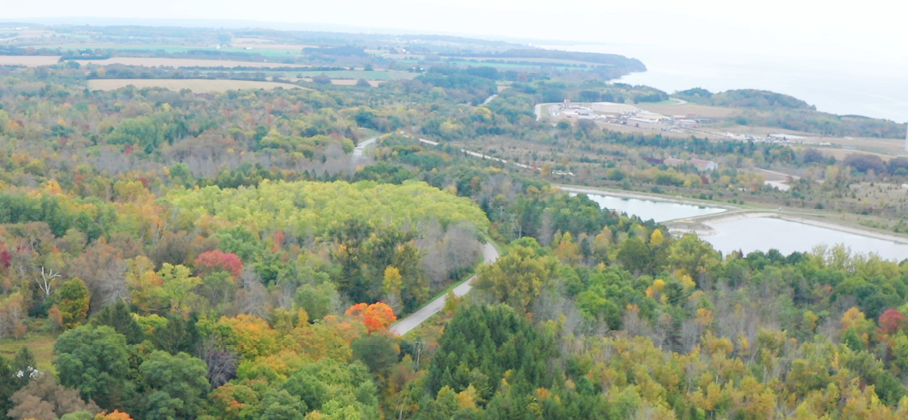
- ~1,300 acres of land size with water access
- Potential to co-locate other industries
- Existing access to transmission, railways and roads
- Adjacent to the Durham Region clean energy corridor which is home to Pickering and Darlington Nuclear Generating Stations.
|
| How much will the project cost? |
|
We are currently in the early stages of project assessment and feasibility. As the project develops the overall cost of the project will become more certain.
|
| Will the community be involved? |
|
Yes. There are a number of ways in which the community can participate in the project process. In early 2026, the Impact Assessment Agency of Canada (IAAC) initiated the Federal Impact Assessment Process. IAAC is a federal agency that reviews major projects to ensure that sustainable development, protection of the environment, and Indigenous Peoples rights are upheld. The IAAC has a number of public commenting periods throughout their process. For more information, visit the IAAC webpage for the Proposed New Nuclear project at Wesleyville.
Additionally, a little further in the process, the Municipality will need the community’s help to shape the vision for how this proposed project serves to benefit Port Hope now, and into the future. Widespread community engagement, conducted by Port Hope, is to begin in 2027.
Finally, OPG, as the proponent of the project, also places great importance on building strong relationships and partnerships with host communities, neighbours and Indigenous Nations on whose traditional territory they operate. OPG offers multiple opportunities for input and an ongoing program of public education and engagement. This engagement began in early 2026 and is continuing.
|
| What are the next steps once the municipality and Indigenous Nation signals their interest in exploring the potential for new nuclear development? |
|
For the site exploration, baseline studies around various environmental and archaeological considerations (noise, light, species at risk, etc.) are conducted. This work would include some drone assessments, on-site monitoring equipment and bore hole drilling to gather geotechnical information. Most of this work is largely unobtrusive.
In parallel with the site assessment work, OPG would begin exploring how best to attract and co-locate other economic development activities to these areas.
|
| How has the Municipality been involved in exploring new nuclear in Port Hope to date? |
|
The Municipality of Port Hope has played an active and ongoing role in the early stages of exploring new nuclear development. To date, Council has received multiple presentations on the project and has passed resolutions authorizing municipal staff to continue working with Ontario Power Generation (OPG) as the process progresses.
The Municipality has also entered into a Memorandum of Understanding (MOU) with OPG to support the continued exploration of the opportunity and to ensure the Municipality remains informed and involved. The Mayor and senior municipal staff regularly engage with OPG to receive updates, ask questions, and better understand potential benefits, impacts, and next steps.
In addition, the Mayor and the Chief Administrative Officer (CAO) have been actively advocating for Port Hope’s interests by engaging with provincial decision-makers, including meetings with provincial ministers and the Premier of Ontario. This involvement ensures that the Municipality’s priorities and concerns are clearly communicated as discussions continue.
|
| How long is the process to develop new nuclear generation? |
|
It will require several years for OPG to undertake the necessary work, in collaboration with the Municipality and Indigenous Nations, before it can be determined whether the site can proceed to support new power generation.
Any decision to proceed with new generation would undergo a regulatory process with public input throughout to verify conclusions. Only then could preparation of the site begin.
Additional licenses, at each phase in the life cycle of the power plant, would also be required, each with public engagement opportunities and public regulatory hearings.
In total, it could take approximately 15 years before the first generating unit is connected to the grid.
|
| What size would a new generation facility at Wesleyville be? |
|
The size of a facility would depend on the type of nuclear technology that is suitable for the property and surrounding area.
Early studies indicate the Wesleyville property could potentially host a significant amount of generation, up to 10,000 MWs, which could power the equivalent of ten million homes.
|
|
How, specifically, would Port Hope benefit from agreeing to host a new large nuclear generation project?
|
|
The Conference Board of Canada studied the potential economic benefits of constructing a large nuclear generation project at the OPG Wesleyville site, using a scenario of 8,000-10,000 MWs station (which could power 8 to 10 million homes), and pulling from other large nuclear projects as benchmarks.
The benefits were calculated separately for the design and construction phase, projected at approximately 25 years, and the operation and maintenance phase, estimated at 70 years. The total project lifespan, including refurbishment and decommissioning, was estimated to be approximately 95 years.
Conservatively, the key potential benefits to Port Hope over the project’s life are as follows:
- From its inception through to its operations, the nuclear facility would boost GDP in Port Hope by $65.7 billion.
- It would generate $10.5 million in municipal tax revenues annually for Port Hope.
- It would boost overall employment levels an average of 15 to 20 per cent.
|
| What’s the process if a community is interested in exploring growth opportunities? |
|
As a first step, interested communities can request funding, if needed, to support them in exploring the generating options, so they have the expertise to make informed decisions.
The next steps would be to work towards a broader willing host Memorandum of Understanding (MoU) and subsequently, a Host Municipal Agreement, with additional funding provided as various milestones are reached.
The total amount of funding would be contingent upon the size and scope of potential new generation development. This will be explored through OPG’s engagement and site assessment process.
This milestone-based funding structure would be used to ensure municipalities are equipped to support a generation project from a community infrastructure perspective.
OPG would also undertake parallel public education and engagement activities to ensure local residents can participate and provide their input.
There will be many opportunities to do this leading up to and throughout the project development period.
|
| Will the funding only go toward supporting nuclear projects? |
|
No, but the amount will be determined by the technology, size, scope, and development impacts. Nuclear builds are large, lengthy undertakings that require supporting infrastructure. Funding support for such a project would therefore be considerably larger.
|
| What happens if a municipality or Indigenous community says “no” to new generation development? |
| Projects will only be explored if they have a willing host community and Indigenous participation. |
| What about Nanticoke and Lambton? |
| Wesleyville is being prioritized for site assessment work because the First Nations and the municipality have expressed interest in exploring nuclear generation development. We will continue our discussions with communities in both Lambton and Nanticoke. |
| What is an impact assessment and when will it be conducted for the Wesleyville site? |
|
A federal impact assessment (IA) is overseen by the Impact Assessment Agency of Canada and examines the potential positive and negative effects of proposed projects. This information helps identify potential impacts, mitigation measures, and enhancement to positive impacts. Throughout the IA process, assessments will thoroughly evaluate potential impacts to local ecosystems, water quality, wildlife habitats and breeding areas. The IA at the Wesleyville site officially began in Q4 2025 and will be accessible to the public to ensure ongoing transparency and community engagement.
|
| What are the considerations around the cumulative impacts of this project and other operating nuclear facilities in the region? |
|
A federal impact assessment will include an assessment of cumulative effects to estimate any impacts of potential new nuclear generation at Wesleyville combined with other existing operating nuclear facilities in the region, as well as other past, present or future nuclear and non-nuclear projects that are reasonably foreseeable.
|
| As part of current operations, what testing does OPG nuclear do on the discharged cooling water before it is returned to the lake? |
| As part of current operations at the Darlington and Pickering nuclear generating stations, lake water is used as an external cooling source to condense the steam that is used to generate electricity. The lake water circulates in a closed-loop system and does not interact with radioactivity. OPG conducts rigorous testing on effluent water before it is discharged back to the lake to ensure environmental safety and compliance with regulatory standards. |
| What types of nuclear waste does a nuclear station generate? How is it safely stored? |
|
Nuclear waste generated at OPG’s stations can be divided into three categories. Low-level waste (LLW) includes worker garments, small tools and material used in the stations such as plastic and paper. Intermediate-level waste (ILW) includes resins, used reactor components, and filters used to keep water systems clean. High-level waste (HLW) consists of used fuel. As part of current OPG operations, LLW and ILW are processed and placed in interim storage. HLW is placed in wet storage to allow the fuel to cool for up to ten years before being placed in dry storage at the station site. Under the Nuclear Fuel Waste Act and the Integrated Strategy for Radioactive Waste, the Nuclear Waste Management Organization (NWMO) is federally responsible for the long-term management of all of Canada’s high and intermediate-level waste. NWMO planning includes a Deep Geologic Repository in service in the mid-2040s for Canada’s used fuel and intermediate-level waste
|
| How would waste be managed at a new nuclear facility at Wesleyville? What measures would be in place to ensure safety and address potential environmental impacts? |
| All energy sources create waste and by-products. The nuclear industry is the only energy industry that accounts for and manages all of its nuclear waste and by-products, which are safely stored and managed. OPG has been safely managing waste for more than 50 years. We prevent and minimize waste before it's created, manage the waste in our care, and harness waste and by-products to make isotopes. Management of the waste from new nuclear generation at Wesleyville will be assessed through the impact assessment. |
| What is the potential timeline for new nuclear generation at Wesleyville? |
| As a first step, OPG initiates a multi-year process to assess the site, identifies a suitable generation technology, and completes a range of impact assessment activities to ensure there were no adverse social or environmental impacts that couldn’t be mitigated. Participation of Indigenous and local communities is essential to this process. Should a new generation project be approved, a subsequent multi-year regulatory process is initiated with public input throughout, including through public regulatory hearings. The decision to proceed with a nuclear generation project will ultimately be decided by Rightsholders, local government, the residents of Northumberland, and the Canadian nuclear regulator. |
| What updates are available regarding changes to the Wesleyville project, including the project scope, timelines, and strategic site selections? |
|
Updates on the Wesleyville project will be provided regularly through our website (from the municipal/political perspective) and OPG’s website (for project scope. timelines, and strategic site selections) as the main repository of information. OPG also has a variety of other engagement channels, including newsletters, information sessions, workshops, and community meetings that offer an ongoing and varied approach to information.
For in-person information, OPG has a community office in Port Hope to facilitate direct communication with the local community. This office is called the Nuclear Discovery Centre and it is located at 115 Toronto Road.
|
| Will there be an impact to surrounding properties or Lakeshore Road because of this project and how will the construction of new roads impact traffic patterns, noise levels, and local infrastructure? |
|
Initial assessments conducted by OPG include an assessment of traffic, including the current conditions and use of roads that could be affected by future project activities. This assessment will consider access routes, traffic flow conditions including expected traffic volumes and resulting impacts (i.e.,: noise) for each phase of the potential project (e.g., construction, operation). Traffic count surveys of the local area will be included in those assessments. The information gathered in this early assessment stage will be analyzed, and mitigation strategies determined, as required, through the impact assessment process that will take place over the next several years.
|
| What job opportunities will be created by the project, and how can community members apply for positions? |
| According to the Conference Board of Canada’s conceptual analysis, roughly 1,700 jobs will be supported during the design and construction phase and 1,600 during the operation and maintenance phase of the potential project; an average 15 to 20 per cent boost to overall local employment levels. Community members can apply for a variety of positions through our website, and job fairs. |
| What is the size and generating capacity of the potential nuclear station at Wesleyville? |
|
The size of a facility would depend on the type of nuclear technology that is suitable for the 1.300 acre property and surrounding area. Early studies indicate the Wesleyville property could host up to 10,000 MWe of electricity, which could power the equivalent of ten million homes.
|
| What types of nuclear technology are being considered, and what are their safety, efficiency and environmental impacts? What is the timeline for technology selection and implementation? |
| Over the next several years, detailed evaluations of a range of nuclear technologies will be conducted to select the most suitable technology using a criterion that includes safety, efficiency, environmental impact, and economics. |
| What is an exclusion zone and what size is the exclusion zone for this project? Will OPG expropriate land? |
|
The Canadian Nuclear Safety Commission (CNSC) defines an exclusion zone as “a parcel of land within or surrounding a nuclear facility on which there is no permanent dwelling and over which a licensee has the legal authority to exercise control”. An exclusion zone supports comprehensive safety and emergency planning designed to protect the public and the environment. Very early conceptual assessments indicate that the bounding exclusion zone for all potential technologies is feasible within the OPG-owned lands. The exclusion zone considerations and impacts will be thoroughly assessed as part of the Impact Assessment process. OPG does not have the ability to expropriate land.
|
| How will the decision-making process behind the project involve stakeholders, and what approval procedures are in place? |
|
The Municipality and OPG places great importance on building strong relationships and partnerships with the community and Indigenous Nations. Exploring new power generation is a complex and lengthy process that includes multiple opportunities for input and an ongoing program of public education and engagement. The decision to proceed with nuclear power will ultimately be decided by local government, Rightsholders, the residents of Northumberland, the Impact Assessment Agency of Canada, and the Canadian nuclear regulator, the Canadian Nuclear Safety Commission (CNSC)
|
| How will the project engage with Indigenous communities and respect their rights and perspectives? |
|
The Municipality and OPG acknowledges the importance of early involvement of Aboriginal and Treaty Rightsholders and is committed to creating lasting mutually beneficially relationships with Indigenous Nations and communities. Both the Municipality and OPG has begun early engagement with Aboriginal and Treaty Rightsholder Indigenous Nations proximate to the Wesleyville site, to ensure they have a voice at the table, including participation in impact assessment activities.
|